Promise Pharmacy Compounded Tirzepatide Review (2026): What Actually Arrived, What the Label Says, and How Long It Is Good For
Author
Date Published
- Twitter
- Facebook
- LinkedIn
- Instagram
- Copy Link
Quick answer: Promise Pharmacy in Palm Harbor, Florida compounded and shipped my order in a sealed mylar pouch by UPS Next Day Air. The gel packs were soft on arrival, which the pharmacy's own insert says to expect, and the vial was still cold. The label read tirzepatide with pyridoxine at 20/10 mg per mL, 1 mL fill, with a beyond-use date 90 days after the compounding date.
This article is drawn from the GLP Winner provider review series. The order described here was placed through Shed, a GLP Winner partner, which means we have a commercial relationship with them. Neither Shed, nor Promise Pharmacy, which compounded and dispensed the medication, paid for this article, saw it before publication, or directed its conclusions. GLP Winner pays the reviewer for their time. Some details about the reviewer are not shared to protect their privacy.
For the ordering process, pricing, the two-month minimum, and the cancellation policy, read the full Shed Compounded Tirzepatide Review (2026). This article is only about what the pharmacy sent.
Have questions or concerns? Reach out to the team here.
Who reviewed this shipment?
I am a woman in my 20s who has been on compounded tirzepatide for a while, running a 5 mg weekly dose drawn as 50 units. I have unpacked enough of these boxes to know what a normal one looks like, which is most of why I can tell you what stood out about this one. I ordered through Shed. Promise Pharmacy is who actually made and mailed the medication.
How did the Promise Pharmacy order arrive?
It came UPS Next Day Air in a padded brown bubble mailer, shipped from Promise Compounding Pharmacy. The return address names the pharmacy, so it is not what I would call discreet if that matters to you.
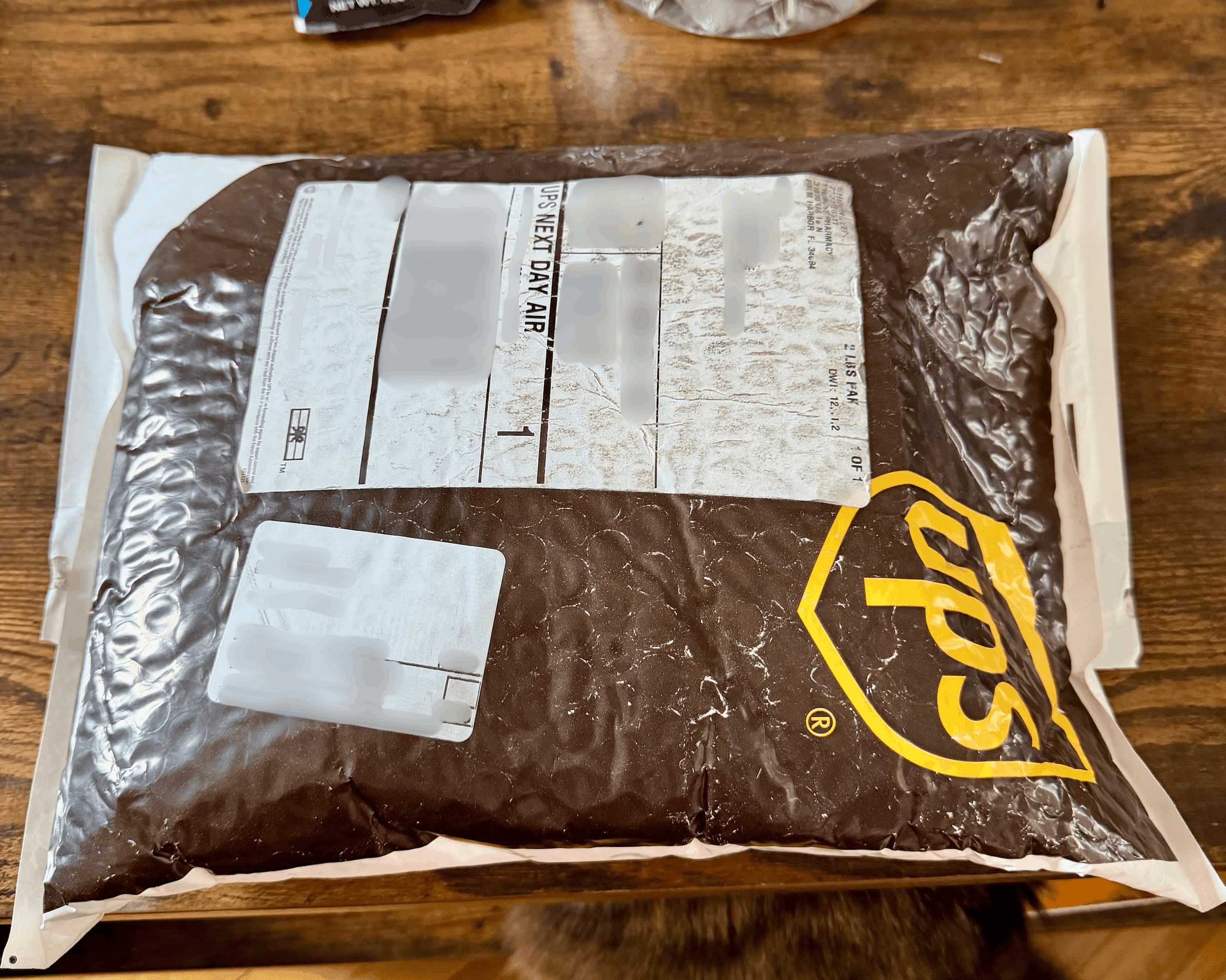
The mailer as it arrived. The pharmacy name is on the return address.
The medication was filled on September 1 and delivered on September 2. Once Promise Pharmacy had the order, it moved in a single day, which is genuinely fast. The provider’s own email had told me to expect 7 to 10 days from the point the order reached them.
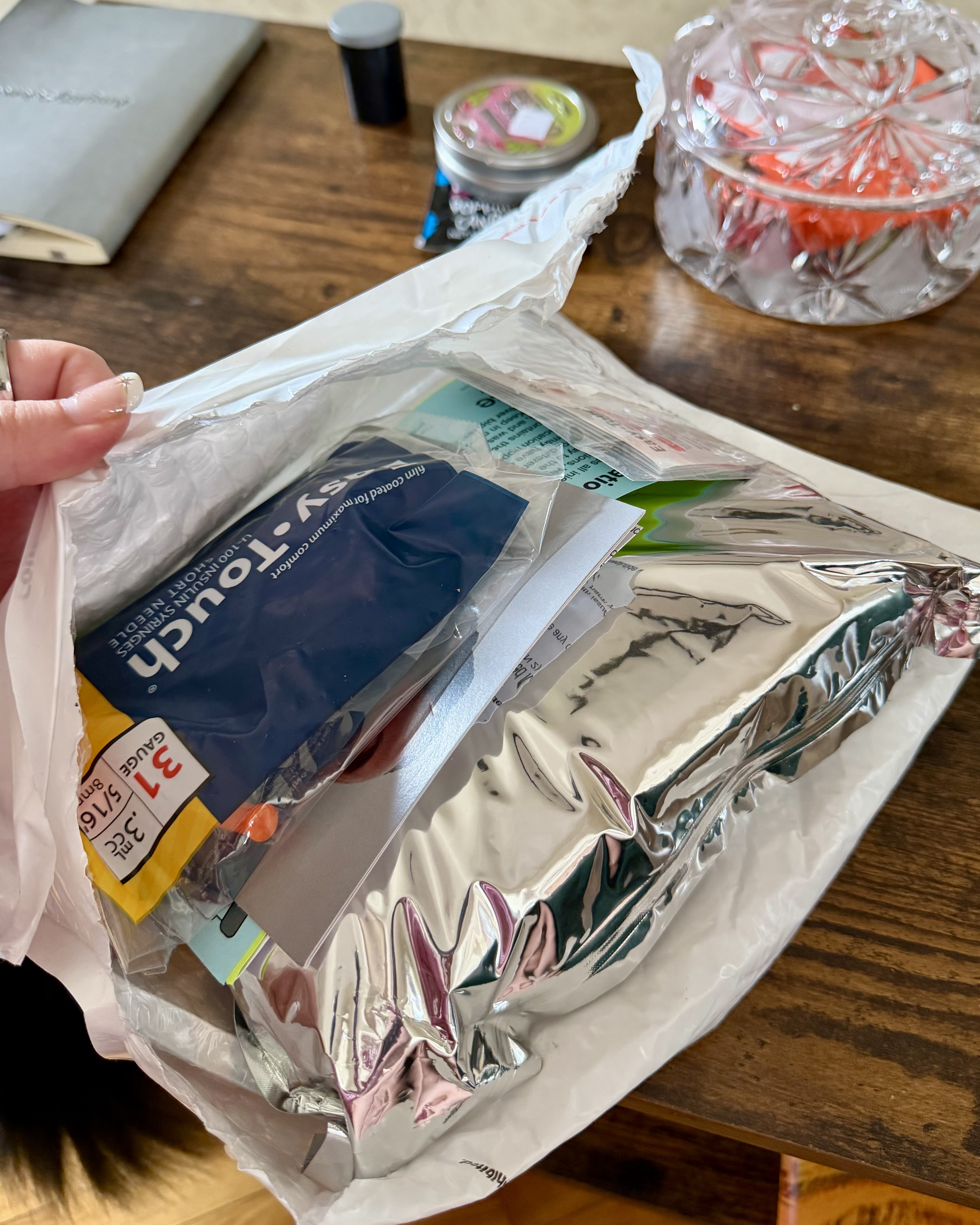
Opening it: mylar pouch, syringes, and paperwork.
Inside the mailer was a sealed silver mylar pouch stamped REFRIGERATE UPON ARRIVAL and MEDICATION INSIDE in red, with the Promise Pharmacy logo on it. Inside that pouch were two Nordic Ice gel packs and the vial.
Did the medication arrive cold?
The vial was cold when I unpacked it. The gel packs were not.
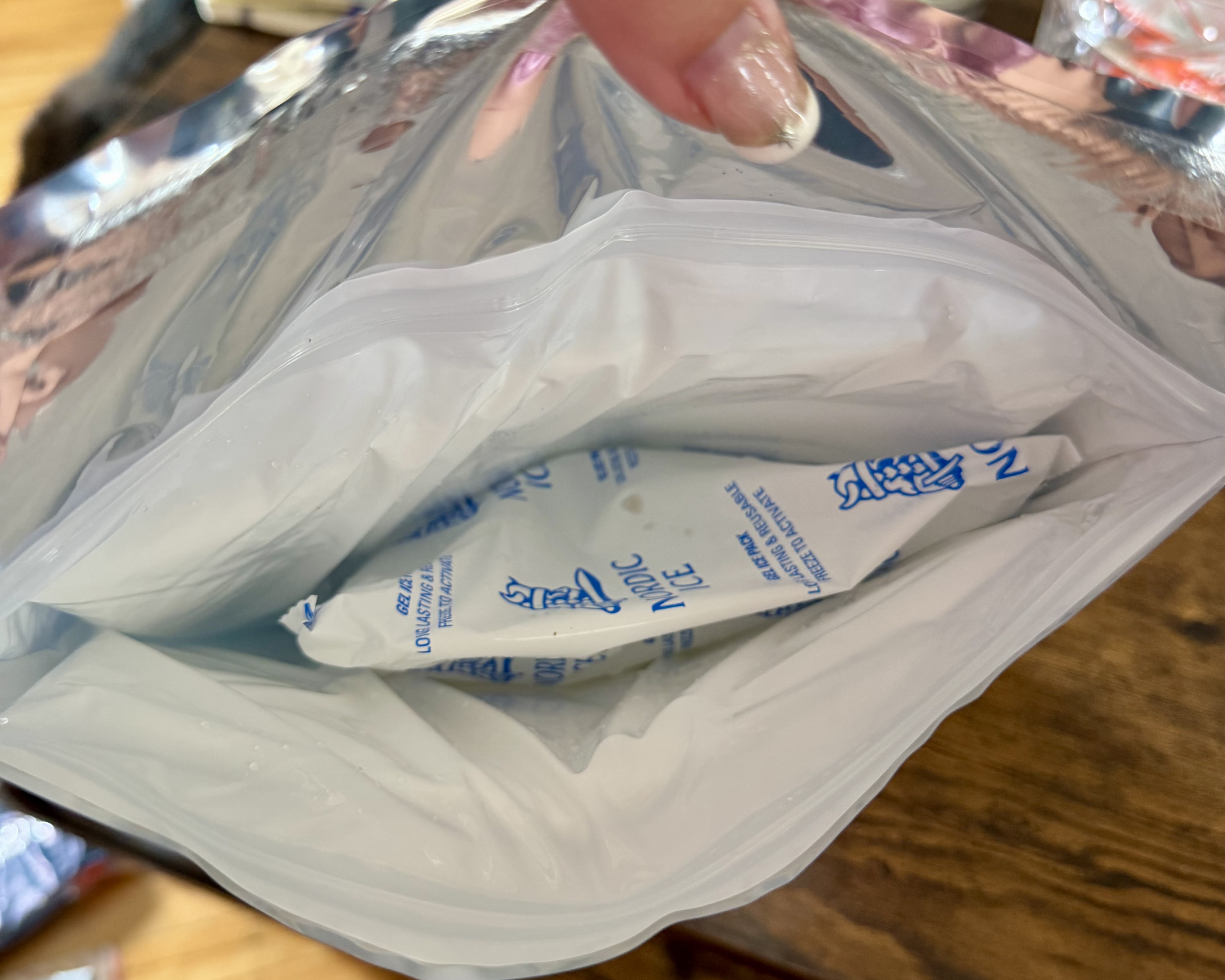
Two Nordic Ice packs, soft on arrival, which the pharmacy says to expect.
This is the part I would have worried about a year ago, and Promise Pharmacy heads it off before you can. A bright yellow sheet sits on top of everything, in capital letters, and it says the ice packs are not required to be frozen in order to keep the medication stable, and that in most cases they will be fully thawed when you receive them.
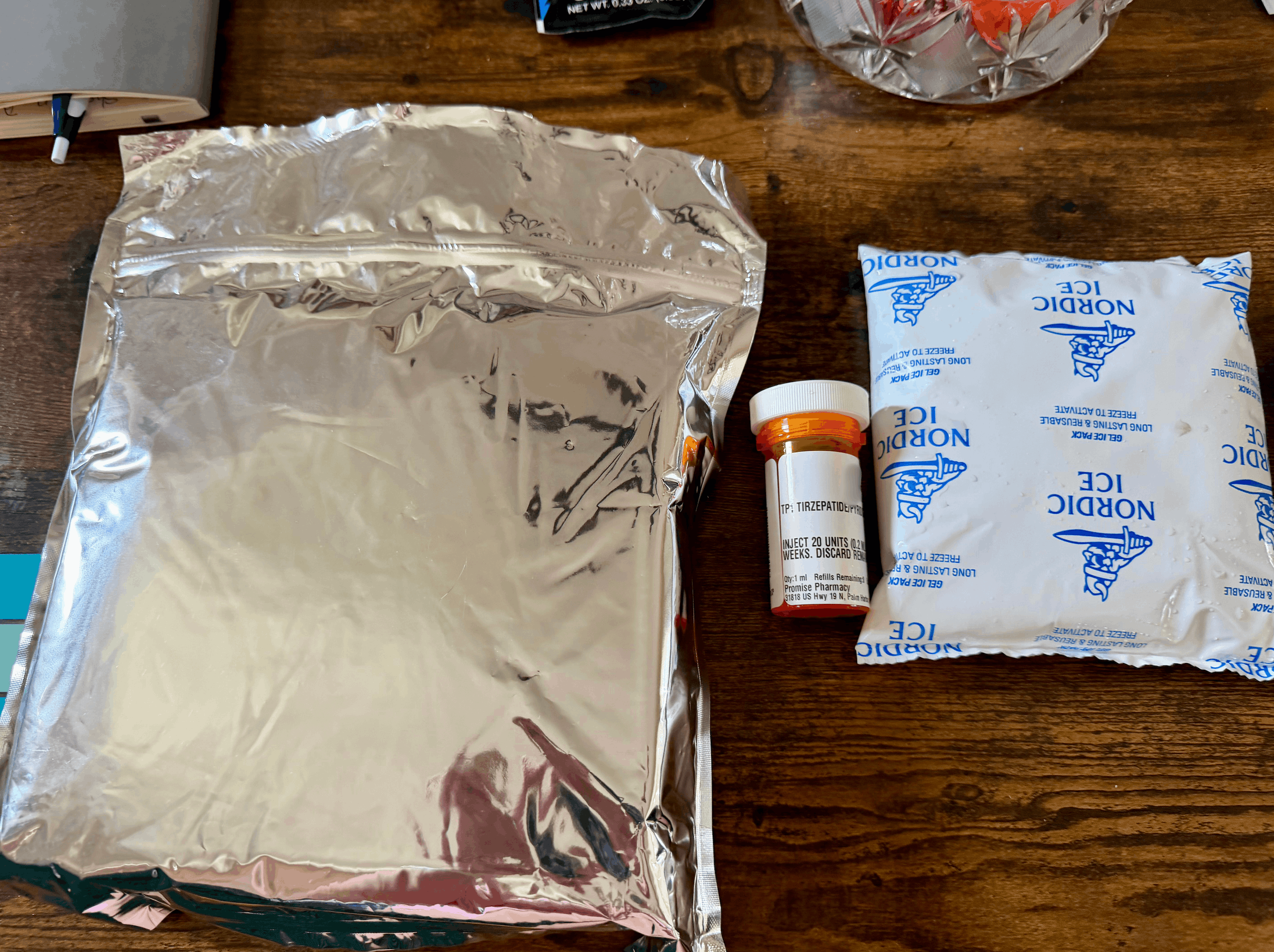
Pouch, bottle, and gel pack.
The full sheet reads:
- Do NOT throw away any packaging or ice until you confirm ALL items are present.
- If any questions on contents, keep ALL packaging and ice and call Promise Pharmacy immediately: 727-772-0500.
- Examine if the package requires you to further open it to obtain prescriptions that are temperature sensitive. Look for items that say "MEDICATION INSIDE."
- If present, ice packs are NOT required to be frozen in order to keep the medication stable. In most cases, they will be fully thawed upon receiving.
I have gotten soft ice packs from other pharmacies with nothing explaining them, and I spent that evening googling instead of injecting. Putting this on a bright yellow sheet on top of the box is a small thing that solves a real problem.
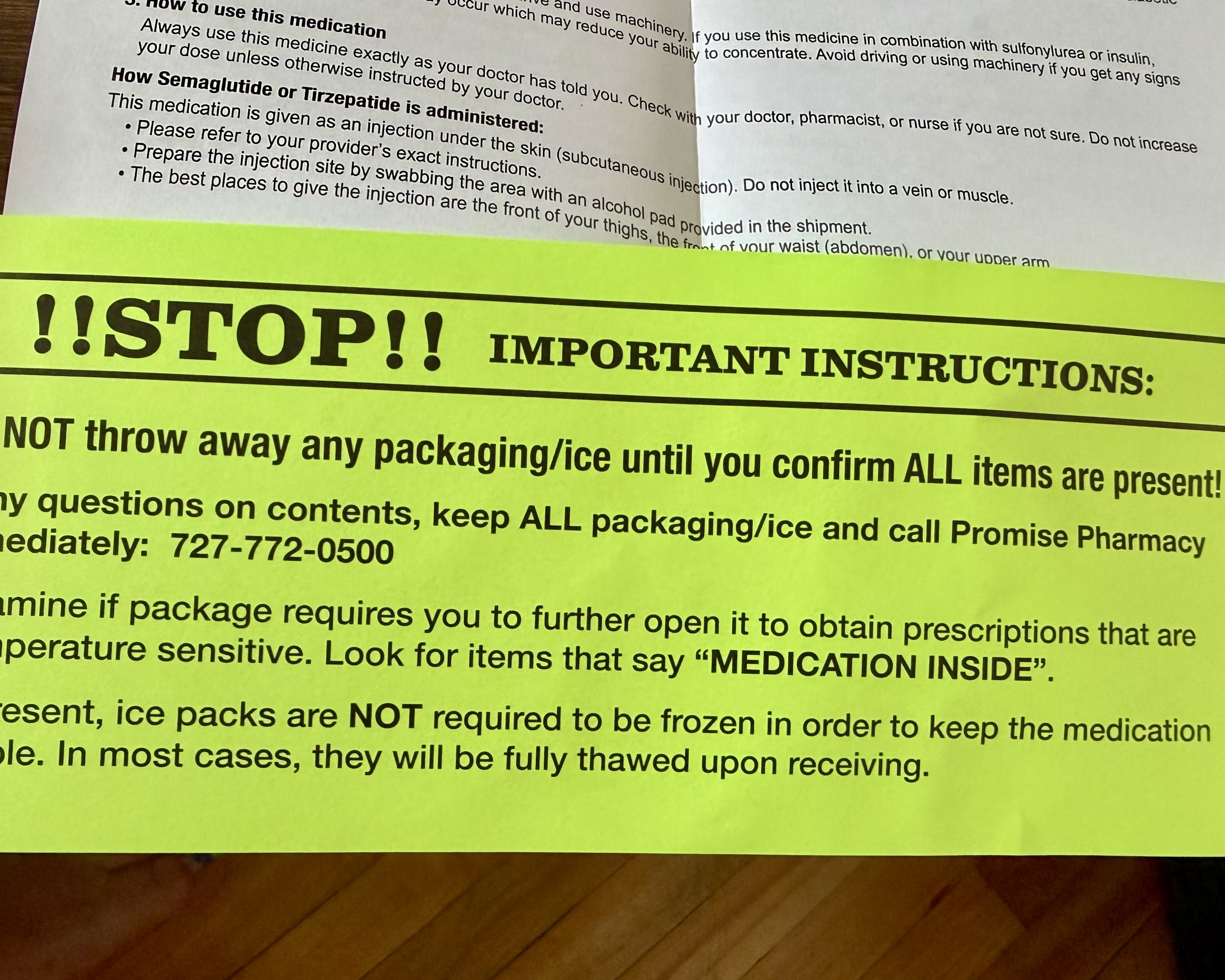
The yellow STOP sheet. It tells you the soft ice packs are normal before you have a chance to worry about it.
Find a provider in your state
Answer a few questions and see live pricing from the providers that ship where you live.
What does the Promise Pharmacy label say?
The vial is amber glass with a green flip cap, and it arrives inside an orange pharmacy bottle. There are two labels to read, and they say different things.
The outer pharmacy bottle reads TP1 TIRZEPATIDE/PYRIDOXINE 20/10 MG/ML INJ SOLUTION, with directions to inject 20 units (0.2 mL) subcutaneously weekly for 4 weeks, discard remainder. Quantity is 1 mL. Refills remaining: 0. It names the prescriber, a D.O., and it carries two separate dates: date compounded 08/21/26 and date filled 09/01/26. Storage is "Store in refrigerator." Beyond-use date is 11/19/26. The dispensing pharmacy is Promise Pharmacy, 31818 US Hwy 19 N, Palm Harbor, FL 34684.
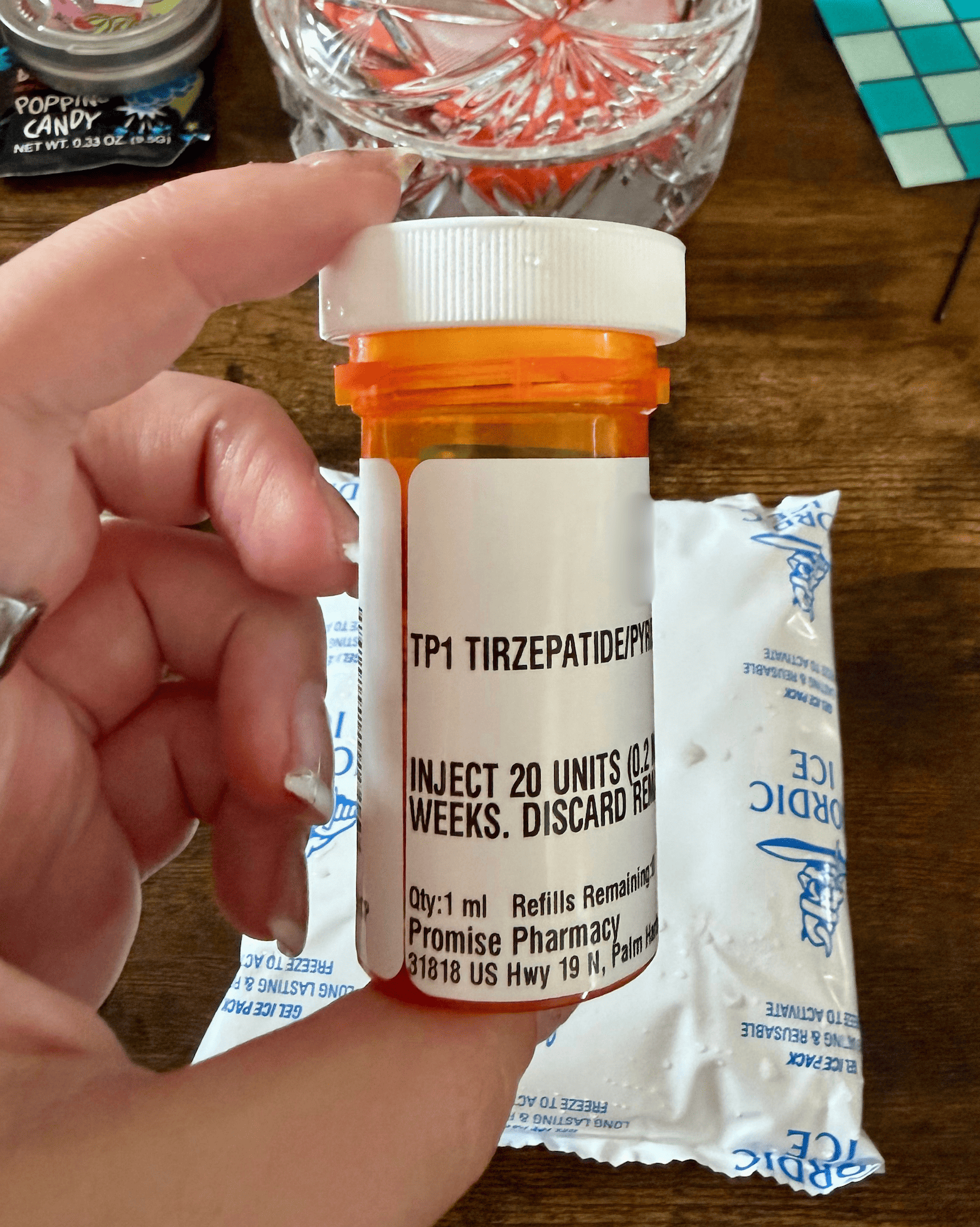
The outer pharmacy bottle: inject 20 units, 0.2 mL, weekly for four weeks.
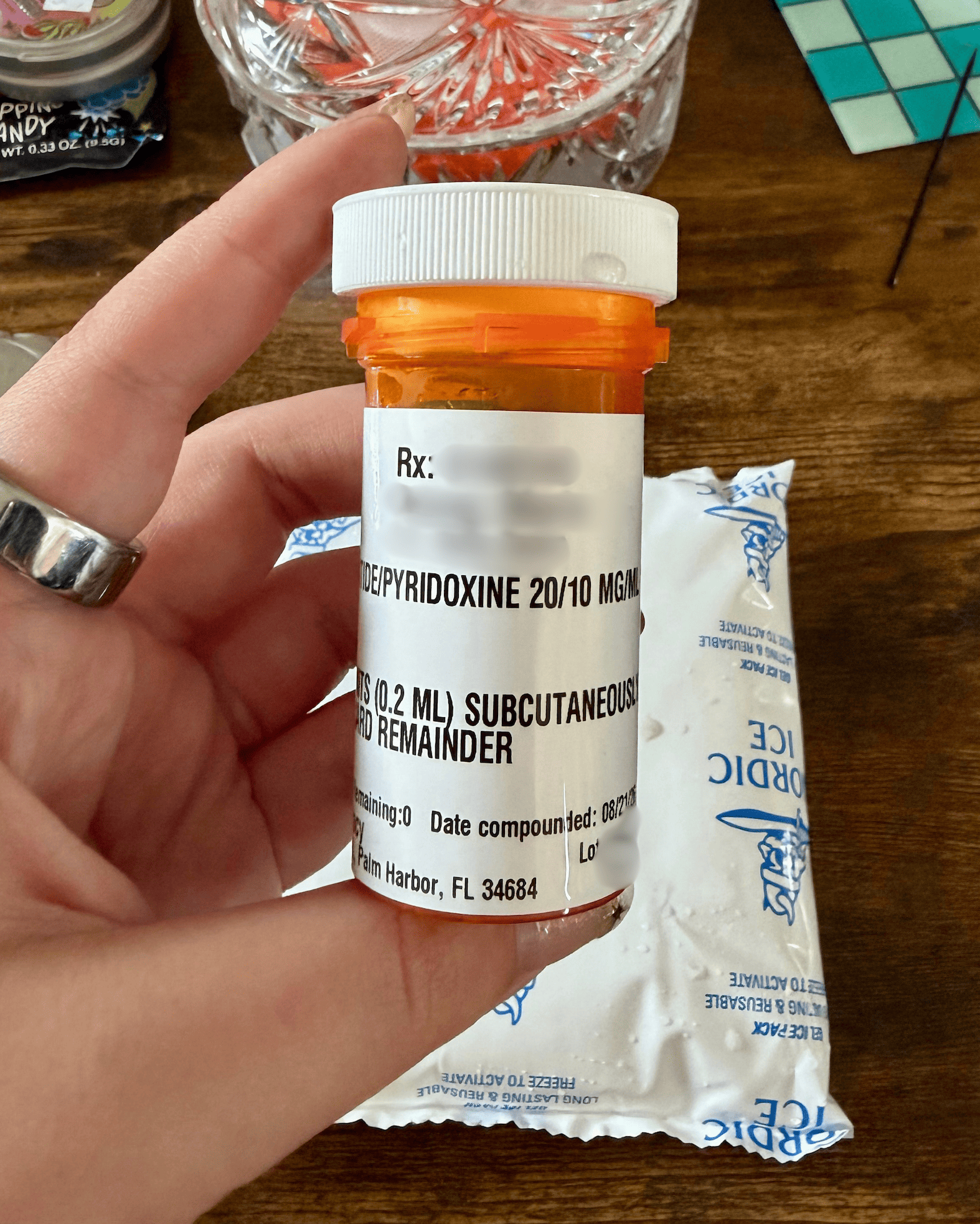
The strength line, 20/10 mg/mL, and the date compounded.
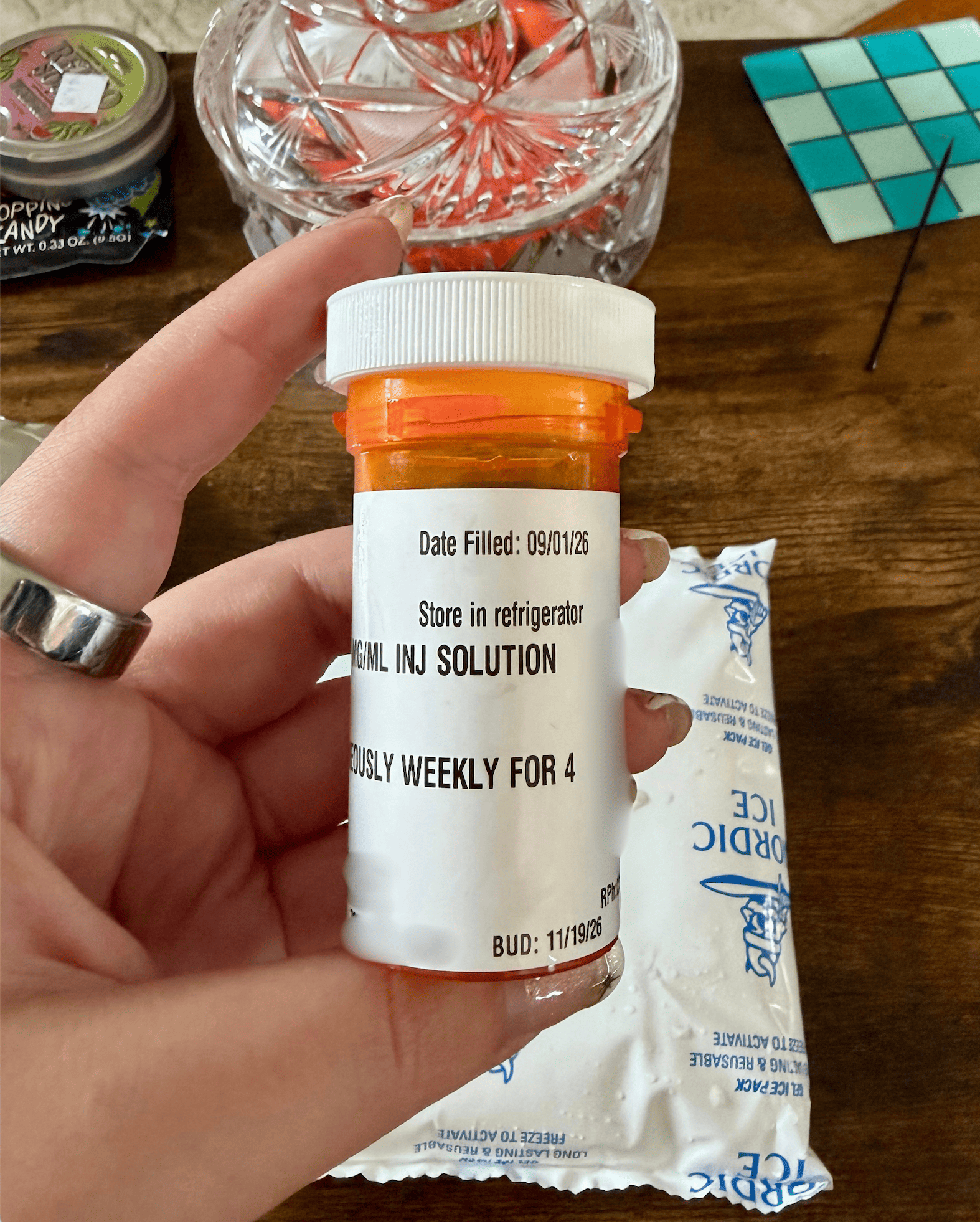
Filled 09/01/26, beyond-use 11/19/26.
The vial underneath carries its own label, and this is the one worth reading twice. It reads TIRZEPATIDE + PYRIDOXINE, 20mg/10mg/ml injection, 1ml, Rx Sterile. Below that: "Compounded Prescription. Not for resale. Subcutaneous use. Storage: Keep Refrigerated." Then a lot number, a use-by date of 11/19/2026, and the line that matters most once you open it: "Multi-dose vial. Discard after 28 days of first use."
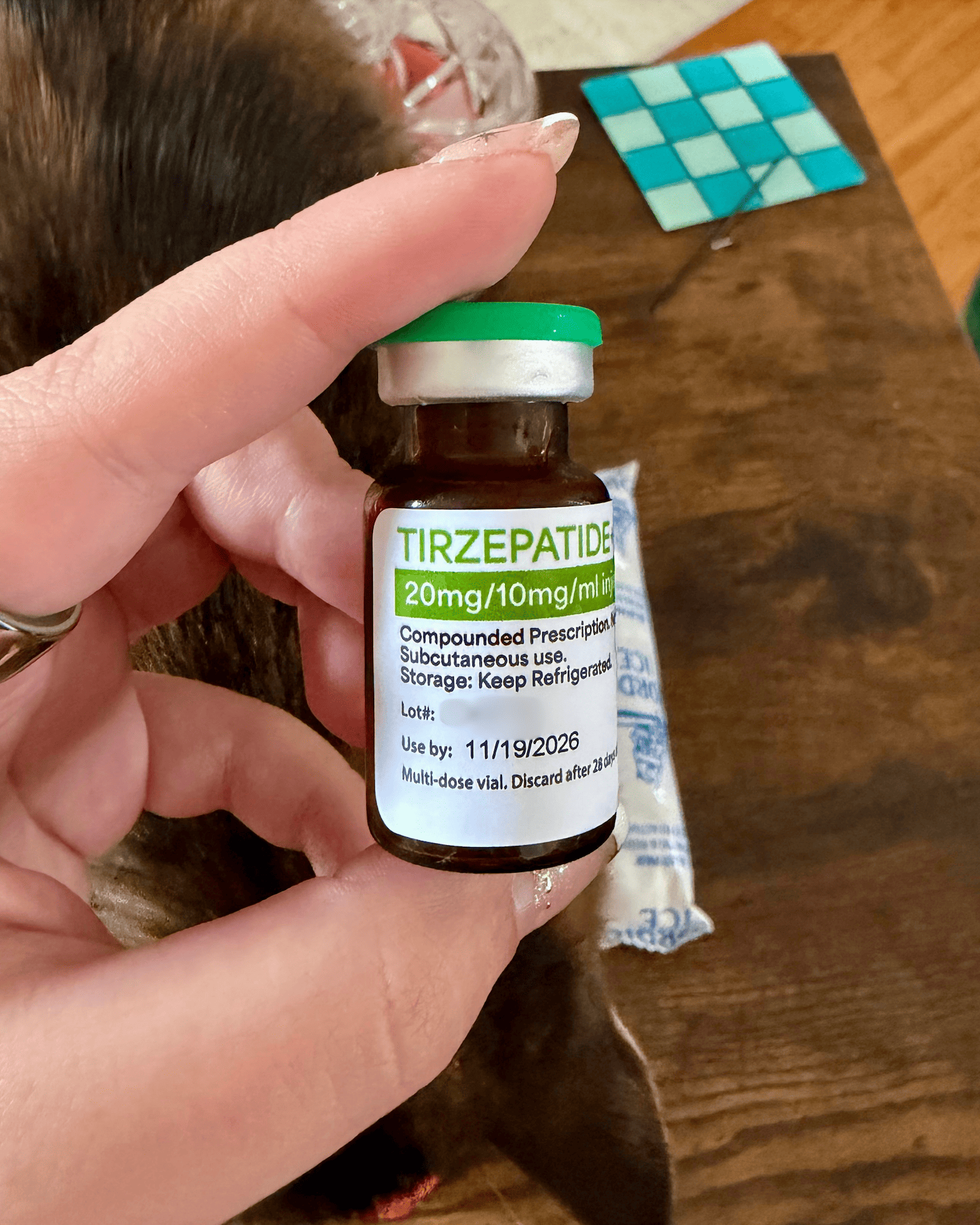
The vial itself: 20mg/10mg/ml, multi-dose, discard 28 days after first puncture.
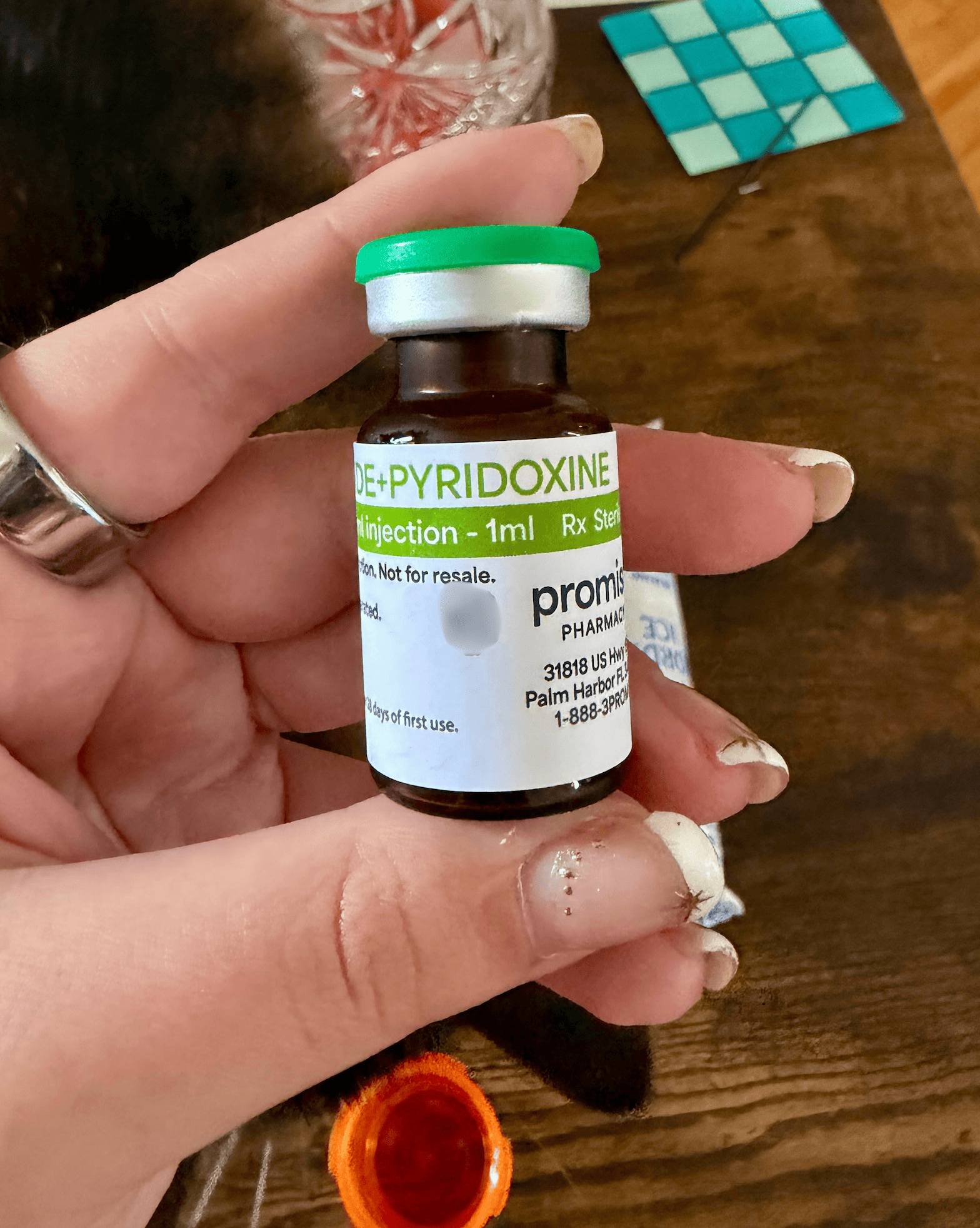
Tirzepatide plus pyridoxine, 1 mL, Rx sterile, not for resale.
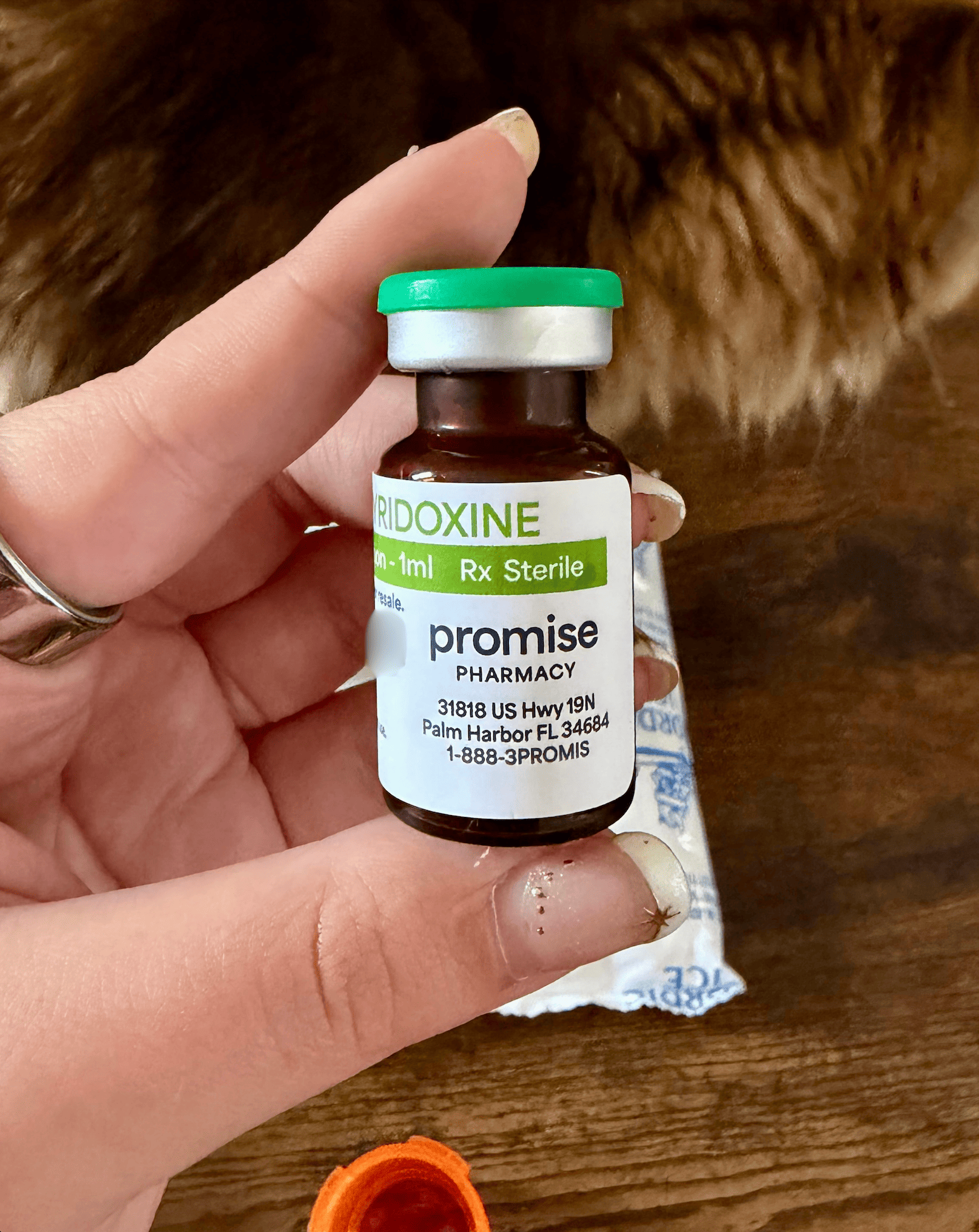
The pharmacy names itself right on the vial, address and phone included.
The pharmacy putting its own name, street address, and phone number is on the vial itself, which gives you a pathway to tracing the safety of the medication.
What is the pyridoxine in the vial, and what dose is 20 units?
Pyridoxine is vitamin B6. This is a combination compound, tirzepatide plus B6 in the same solution, which is common in compounded GLP-1s and is why the strength reads as two numbers.
The math is the part people get wrong, and why we have an article on the relation between dose and units. The tirzepatide concentration is 20 mg per mL. My directions were 20 units, which on a U-100 insulin syringe is 0.2 mL. That works out to 4 mg of tirzepatide per dose. At four weekly doses, that is 0.8 mL drawn out of a 1 mL fill.
If you are used to reading units rather than milligrams, the same number of units can mean a completely different dose at a different concentration. I had been drawing 50 units at my previous concentration. Fifty units off this vial would not have been the same medication amount at all. Check the mg per mL on your own label before you assume anything from the unit count.
Why does the vial look mostly empty?
Because the pharmacy dispenses into a bigger vial than your fill, and it includes a card explaining exactly that.

Everything that came in the mailer.
The card says Promise Pharmacy dispenses all injectable medication in 10 mL vials to comply with labeling regulations, that the same vial size gets used for different quantities, and that the volume inside may appear less than you expected. It shows a diagram of what 1 mL through 5 mL looks like in the same 10 mL vial, and it notes that 5 mL is about a teaspoon.
This answers a question I have seen asked in every GLP-1 forum I have ever read. A patient opens a box, sees a vial that looks a fifth full, and assumes they were shorted. Shipping a diagram is a better answer than a support ticket.
What paperwork comes with a Promise Pharmacy order?
More than I expected, and more than I needed, though I would rather have it than not.
What came in the box:
- One amber multi-dose vial containing 1 mL of compounded tirzepatide with pyridoxine (B6), 20 mg/10 mg per mL, inside an orange pharmacy bottle
- A sealed mylar pouch marked REFRIGERATE UPON ARRIVAL and MEDICATION INSIDE
- Two Nordic Ice gel packs
- 10 Easy Touch U-100 insulin syringes, 31 gauge, 3/10 cc, 5/16 inch (8 mm)
- 10 alcohol prep pads
- The bright yellow STOP sheet about packaging and the ice packs
- The Promise Pharmacy "Liquid Medication Volume" card
- A full GLP-1 medication leaflet
The leaflet is a proper multi-page document covering what semaglutide and tirzepatide are, who should not use them, warnings and precautions, how to administer an injection including where on the body, what to do if you miss a dose, side effects sorted into common, uncommon, and rare, and storage.
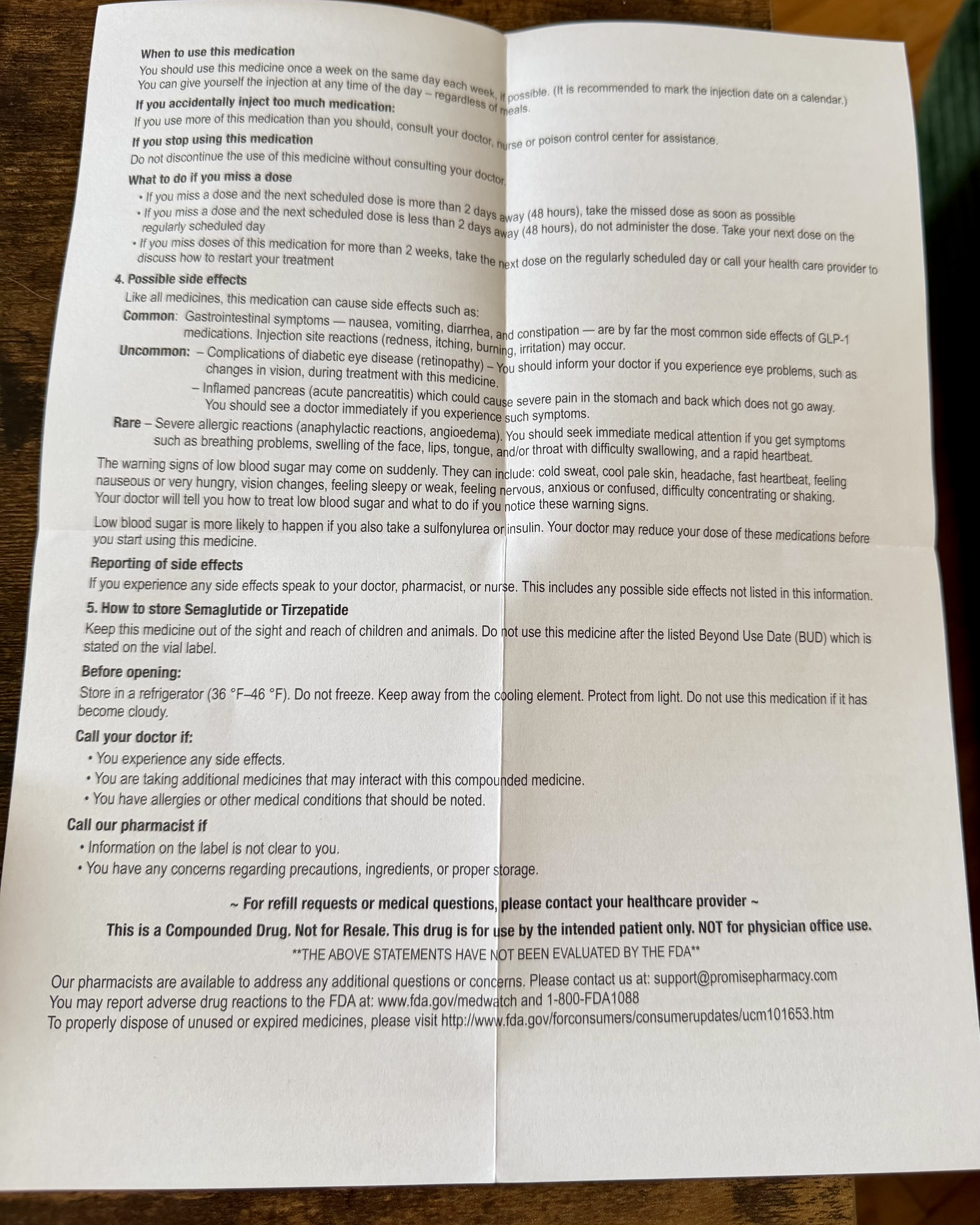
The medication leaflet, front. Contraindications, warnings, and how to inject.
The storage section is specific in a way that is worth transcribing, because it is more than "keep it cold." Before opening: store in a refrigerator at 36°F to 46°F, do not freeze, keep away from the cooling element, protect from light, and do not use the medication if it has become cloudy. It also tells you not to use it after the beyond-use date printed on the vial label, and to keep it out of the sight and reach of children and animals.
The bottom of the leaflet carries the disclosures in bold: "This is a Compounded Drug. Not for Resale. This drug is for use by the intended patient only. NOT for physician office use," followed by "THE ABOVE STATEMENTS HAVE NOT BEEN EVALUATED BY THE FDA." I would rather a compounding pharmacy say that plainly on its own paperwork than leave me to work it out.
Can you reach a pharmacist at Promise Pharmacy?
Yes, and the contact details show up in three separate places in the box, which is three more than some orders give you.
The leaflet says outright: "Our pharmacists are available to address any additional questions or concerns." It lists support@promisepharmacy.com for those questions. It also tells you specifically when to call the pharmacist rather than the prescriber: if the information on the label is not clear to you, or if you have any concerns regarding precautions, ingredients, or proper storage. Separately, it says to contact your healthcare provider for refill requests and medical questions, which is a sensible split.
The yellow STOP sheet gives a direct phone number, 727-772-0500, for anything about the contents or the packaging. The vial label itself carries 1-888-3PROMIS. The leaflet also points you to FDA MedWatch at fda.gov/medwatch or 1-800-FDA-1088 to report an adverse reaction, and to the FDA's consumer page for disposing of unused or expired medicine.
I did not need to call. But knowing which number is for a cold pack question and which is for a "the label does not match what I expected" question, without having to guess, is the kind of thing that only becomes obvious when it is missing.
How long is the medication good for?
Two different clocks, and you need both.
The beyond-use date printed on the vial is 11/19/2026. The vial was compounded on 08/21/26, which puts the beyond-use date exactly 90 days after compounding. Note that it runs from the compounding date, not from the date it was filled and shipped to me, which was 09/01/26. By the time it reached my door, about 79 days of that window were left.
The 28-day discard rule is the one that will actually govern your vial. The label says to discard 28 days after first use, meaning first puncture of the stopper, regardless of how much solution is left or how far away the beyond-use date still is. For a four-week supply drawn at one dose a week, those two line up almost exactly, which is presumably the point.
So: do not let the November date fool you into thinking a half-used vial from October is fine. The clock that matters starts the first time you put a needle in it.
Final Takeaway
The medication arrived cold and the vial was properly labeled. Promise Pharmacy names itself on the mailer, the pouch, the vial, and the paperwork, which makes it easy to know who made what you are injecting. The yellow sheet and the volume card answer the two questions patients panic about, soft ice packs and a vial that looks empty, before either one can turn into a bad evening. Read your own label rather than assuming the unit count carries over from a previous prescription, because the concentration decides the dose. Keep both dates in mind: the beyond-use date on the vial, and the 28 days that start the first time you puncture it. If anything on your label is unclear, the pharmacist's number is printed right there, and that is the call to make.
If you enjoy posts like these, you can subscribe to receive newsletter updates.
Frequently asked questions
Who is Promise Pharmacy?
Promise Pharmacy is a compounding pharmacy at 31818 US Hwy 19 N, Palm Harbor, FL 34684. It compounded and dispensed the compounded tirzepatide described in this article, and it is named on the shipping label, the mylar pouch, the vial itself, and the printed inserts. Its published contact points are 727-772-0500 and support@promisepharmacy.com.
Is Promise Pharmacy the same company as the provider I ordered from?
No. They are two separate businesses doing two different jobs. I ordered through Shed, a telehealth provider, and Shed's clinician wrote the prescription. Promise Pharmacy compounded the medication and shipped it. The provider handles your account, pricing, and support. The pharmacy handles what is in the vial. Everything on the provider side is covered in our full Shed Compounded Tirzepatide Review, linked at the top of this article.
Do you know which pharmacy will fill your order before you pay?
Not in my case. The pharmacy name appeared when the package arrived, not during checkout. If knowing your pharmacy in advance matters to you, it is worth asking a provider before you order, because some name it up front and some do not.
Does compounded tirzepatide from Promise Pharmacy arrive cold?
Mine did. It shipped UPS Next Day Air inside a sealed mylar pouch with two Nordic Ice gel packs. The vial was cold when I unpacked it.
Why were my ice packs melted, and is the medication still okay?
Promise Pharmacy addresses this directly on a bright yellow sheet at the top of the box. It states that the ice packs are not required to be frozen in order to keep the medication stable, and that in most cases they will be fully thawed when you receive them. Mine were soft and the vial was still cold. The same sheet tells you to keep all packaging and ice and call the pharmacy at 727-772-0500 if you have any question about the contents, which is the right move if something looks off to you.
What does 20/10 mg per mL mean on the vial label?
It is a combination compound. The first number is tirzepatide at 20 mg per mL, the second is pyridoxine, which is vitamin B6, at 10 mg per mL. Both are in the same solution, so a single draw gives you both.
How many milligrams is 20 units of this vial?
Four milligrams. On a U-100 insulin syringe, 20 units is 0.2 mL, and at a concentration of 20 mg per mL that comes to 4 mg of tirzepatide. This changes entirely with concentration, so the same unit count on a different vial is a different dose. Check the mg per mL on your own label.
Why does my Promise Pharmacy vial look mostly empty?
Because the fill is smaller than the vial. Promise Pharmacy includes a card explaining that it dispenses all injectable medication in 10 mL vials to comply with labeling regulations, and that the same vial size is used for different quantities. The card shows a diagram of what 1 mL through 5 mL looks like inside that vial. A small fill in a large vial is expected, not a shortage.
What is the beyond-use date, and how long did mine have?
The beyond-use date is the last date the compounded preparation should be used, and it is printed on the vial. Mine read 11/19/2026 against a compounding date of 08/21/26, which is a 90-day window. Because the vial was filled and shipped on 09/01/26, roughly 79 days of that window remained when it reached me.
How long can you use a multi-dose compounded vial after opening it?
My label says to discard it 28 days after first use. That clock starts at first puncture and runs independently of the beyond-use date, so a vial can still be inside its beyond-use date and past its 28 days. For a four-week supply at one dose a week, the two windows land in roughly the same place.
How should compounded tirzepatide be stored?
The leaflet included in my order says to store it in a refrigerator at 36°F to 46°F before opening, not to freeze it, to keep it away from the cooling element, and to protect it from light. It also says not to use the medication if it has become cloudy, and to keep it out of the sight and reach of children and animals. These are the pharmacy's own instructions for this preparation, so follow the ones that come with yours.
Are syringes and alcohol pads included?
Yes. My order came with 10 Easy Touch U-100 insulin syringes at 31 gauge, 3/10 cc, 5/16 inch (8 mm), and 10 alcohol prep pads. At one dose a week that is more than a four-week supply needs.
Can you talk to a pharmacist about a compounded order?
Yes. The leaflet states that Promise Pharmacy's pharmacists are available for additional questions and lists support@promisepharmacy.com. It specifically says to call the pharmacist if the information on the label is not clear to you, or if you have concerns about precautions, ingredients, or proper storage. Refill requests and medical questions go to your prescribing provider instead. The yellow packaging sheet lists 727-772-0500 and the vial carries 1-888-3PROMIS.
How do you report a side effect from a compounded medication?
The leaflet directs you to speak to your doctor, pharmacist, or nurse first, including for side effects not listed in the information provided. It also points to the FDA's MedWatch program at fda.gov/medwatch or 1-800-FDA-1088 for reporting adverse drug reactions directly.
Find a provider in your state
Answer a few questions and see live pricing from the providers that ship where you live.
Keep Reading
A patient unboxes compounded tirzepatide dispensed by The Pharmacy Hub and compounded by BPI Labs: cooler, gel pack, 4 mL vial, labels, storage card.
A $95 peptide vial had a brand, a shop and a lab report. See which signals are easy to fake and what a licensed pharmacy is really held to.

An Australian lab tested 18 vials sold as retatrutide. One matched its label. See what the dosing errors were and why a purity test proves little.
Categories
Written by
 Provider Reviews
Provider reviews are real patients who are paid for their time by GLP Winner. They purchase medications as a patient and write about their experience from start to finish, and share their perspective of their buying experience. Your own experience may vary from theirs, and providers reviewed are never given the opportunity to review the article prior to posting. Providers do not pay for the review or the opportunity to be reviewed.