Calculating Your Calorie Deficit While On GLP-1s
Author
Date Published
- Twitter
- Facebook
- LinkedIn
- Instagram
- Copy Link

Quick note before we start:
This guide is general education, not medical advice. Always talk with your own clinician before changing your diet, exercise, or GLP-1 plan.
Why calorie deficit still matters on GLP-1s
GLP-1 medicines help your body in two big ways for weight loss: they help your pancreas release more insulin when needed, and they slow down how quickly food leaves your stomach, which helps you feel full on less food (Cleveland Clinic).
Some GLP-1s, like Wegovy, are FDA approved for long term weight management when used with a reduced calorie diet and increased physical activity, not on their own (FDA Wegovy Label).
Weight loss still comes down to energy balance: over time, you lose weight when you take in fewer calories than your body uses (CDC Healthy Weight). GLP-1s make it easier to eat less, but they do not erase the need for a calorie deficit.
Because GLP-1s lower appetite, people often eat less protein and fewer total nutrients without realizing it. Recent work highlights the need for “precision nutrition” on GLP-1s so that you lose more fat and less muscle (UC Davis Precision Nutrition In The Ozempic Era).
Step 1: Get a rough estimate of your maintenance calories
Your maintenance calories are the calories your body needs in a normal day to stay the same weight.
You can estimate this by:
- Using a reputable online calculator that asks for your age, sex, height, weight, and activity level, or
- Working with a registered dietitian or clinician who can factor in your GLP-1 medicine and health conditions.
The NIH Body Weight Planner is one example of a tool that estimates how many calories you might need to reach and keep a goal weight (NIDDK Body Weight Planner).
Example, just to ground the math:
- 40 year old woman, 5’6”, 200 pounds
- Light to moderate activity
- Rough maintenance: about 2,200 to 2,400 calories per day
On GLP-1s like Ozempic, Mounjaro, Wegovy, or Zepbound, your real life intake often ends up lower than this number because your hunger drops (UC Davis GLP-1 And Health).
Step 2: Choose a realistic calorie deficit on GLP-1s
Classic weight loss programs often aim for about a 500 to 750 calorie deficit per day in adults not using GLP-1s (CDC Diabetes Prevention Module).
On GLP-1s, you usually do not need that aggressive of a cut, because the drug is already helping you:
- Eat smaller portions
- Feel full sooner
- Think less about food all day (Cleveland Clinic)
For many adults on GLP-1s, a moderate deficit often makes more sense, like:
- Around 300 to 500 calories below your estimated maintenance per day
Example:
- Maintenance estimate: 2,300 calories
- You choose a 400 calorie deficit
- Target intake: about 1,900 calories per day
This kind of deficit, paired with the appetite changes from GLP-1s, can support steady fat loss without pushing your body into “everything is falling apart” mode.
Step 3: Track what you actually eat for 1 to 2 weeks
The only way to know if your target matches reality is to track for a bit. For 7 to 14 days:
- Log everything you eat and drink
- Use a simple app, paper, or notes on your phone
- Try not to “diet harder” in week one, just observe
CDC guidance for healthy weight suggests tracking food and drink as a key tool for learning your real calorie intake and patterns (CDC Tips For Balancing Food And Activity).
After 1 to 2 weeks:
- Look at your average daily calories
- Compare that number to your target (maintenance minus chosen deficit)
If your average intake is much lower than planned, that might be a sign you need to bring calories up, not push harder.
Step 4: Watch for signs that your deficit is too deep
Big clinical trials of semaglutide, like the STEP 1 study, show strong average weight loss, but also make it clear that both fat mass and lean mass can drop during treatment (NEJM STEP 1 Trial) (Impact Of Semaglutide On Body Composition).
A newer systematic review found that semaglutide driven weight loss can include notable lean mass loss in some patients, which has raised concerns about muscle health (Systematic Review Of Semaglutide And Lean Mass).
At the same time, nutrition researchers are warning that many GLP-1 users are not meeting basic targets for protein, vitamins, and minerals because they are simply eating less food overall (UC Davis Precision Nutrition In The Ozempic Era).
Red flags your calorie deficit on GLP-1s might be too aggressive:
- You feel wiped out most days, even with enough sleep
- Your strength is dropping fast in daily life or workouts
- You are rarely hitting your protein goals
- You notice changes in hair, nails, or skin that worry you
When you see this cluster of signals, it is time to talk with your clinician and likely bring both calories and protein up.
Step 5: Protect your muscle while you are in a deficit
You are not just trying to be “lighter.” You are trying to be healthier, stronger, and more stable long term. Lean mass is a huge part of that.
Some semaglutide studies suggest that a meaningful share of weight loss can come from lean mass, especially if protein intake is low and activity is minimal (Systematic Review Of Semaglutide And Lean Mass).
You can tilt things toward fat loss instead of muscle loss by focusing on three pillars:
1. Prioritize protein
Many experts suggest around 1.6 to 2.2 grams of protein per kilogram of body weight per day when you are in a calorie deficit and want to keep muscle (CDC Cutting Calories).
For a 200 pound person, that is roughly 145 to 200 grams per day, spread across meals and snacks.
Because GLP-1s lower appetite, it often works better to:
- Start meals with protein
- Split protein across several smaller meals
- Use shakes or soft options if solid foods feel heavy (UC Davis Precision Nutrition In The Ozempic Era)
2. Strength train regularly
Even simple resistance work 2 to 3 times per week helps your body “decide” to keep muscle while you are losing fat.
CDC guidance notes that physical activity is important for both weight loss and keeping weight off, and strength work is a key part of that picture (CDC Physical Activity And Weight).
3. Choose nutrient dense foods
Every bite counts more when your appetite is lower. Make those bites do double duty.
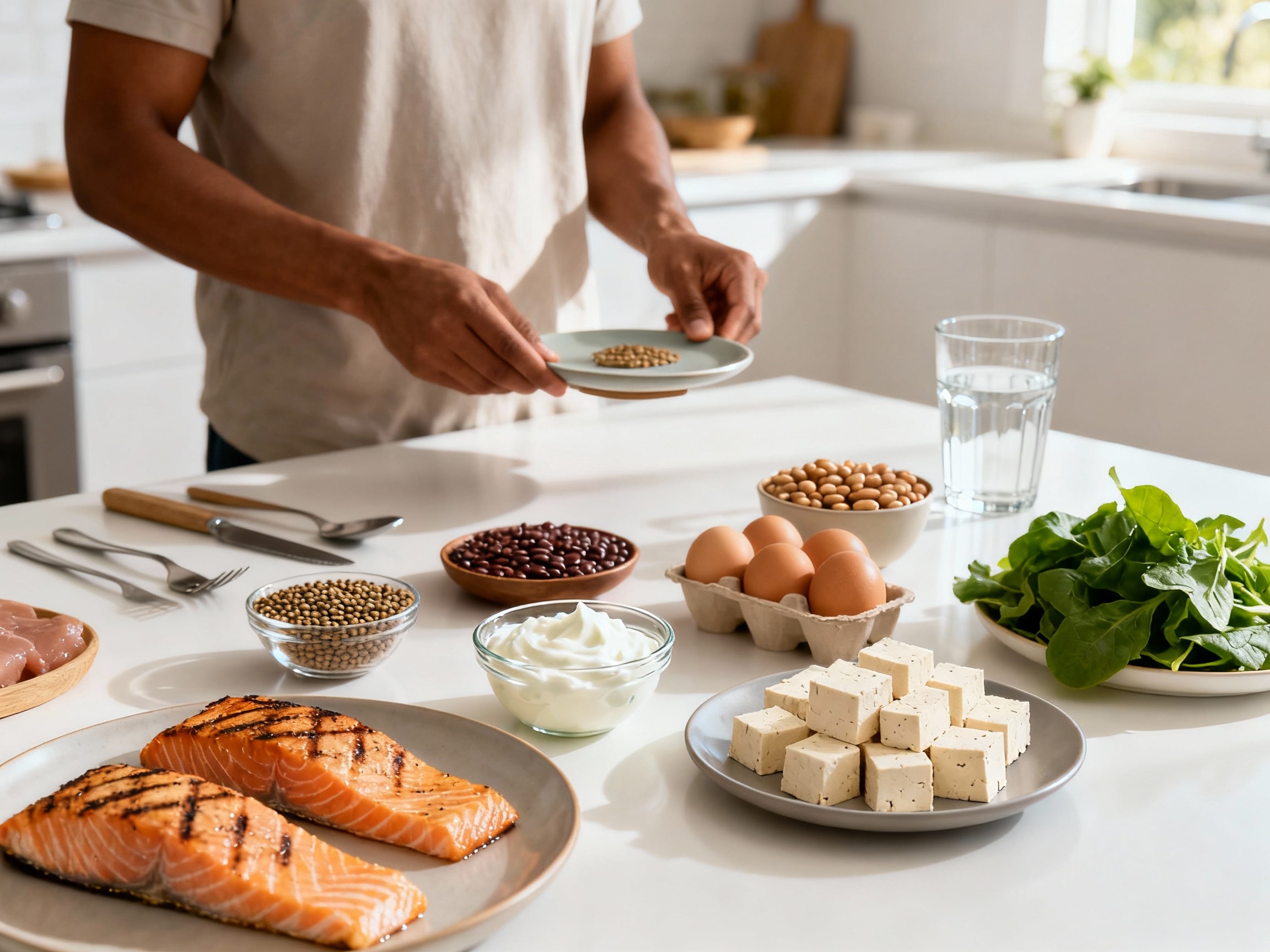
- Lean meats, fish, eggs, tofu, beans, and lentils
- Fruit and vegetables for vitamins and fiber
- Whole grains in portions that fit your calorie target
This kind of pattern matches what CDC and other public health groups recommend for healthy, long term weight management (CDC Tips For Healthy Eating).
Step 6: Adjust for movement and life changes
Your calorie needs are not frozen. They shift as your life shifts.
You may need more calories if:
- You start or ramp up regular exercise
- Your daily movement goes up a lot, like more walking or a more active job
You may need fewer calories if:
- You become less active
- Your weight drops a lot from where you started
CDC notes that people who keep weight off long term usually keep their calories lower than before and stay physically active most days, often 60 to 90 minutes of moderate movement spread out over the day (CDC Tips For Keeping Weight Off).
Checking in on your plan every 4 to 6 weeks is a smart rhythm:
- Look at the trend in your weight, not just one day
- Notice energy, mood, and strength
- Nudge your calorie target up or down with your clinician’s help
Step 7: Plan for “after” GLP-1s
Research and real world experience both show that weight regain after stopping GLP-1s is common if there is no long term plan for food, movement, and energy balance (CDC Healthy Weight) (UC Davis GLP-1 And Health).
Key ideas for the “after” phase:
- Expect hunger to change again as dose changes or stops
- Shift slowly toward maintenance, not from deficit to “anything goes” overnight
- Keep your protein habits, strength training, and tracking skills
- Stay in regular touch with your clinician while your dose and appetite change
Long term success is less about the drug alone and more about the habits you built around it.
Safety, indications, and compounded GLP-1s
A few important guardrails:
- Some GLP-1s are approved only for type 2 diabetes, and some, like Wegovy and Zepbound, are approved for chronic weight management. Only GLP-1s that are FDA approved for weight management should be used for that purpose (FDA Wegovy Label).
- Compounded GLP-1 products are not FDA approved. Their safety and effectiveness have not been established. They are not the same as brand name drugs and should not be described as equal, safer, or better.
- Any calorie deficit or exercise plan must fit your health history, including heart disease, kidney disease, and any history of eating disorders. Your own clinician is the final call.
FAQs about calorie deficit and GLP-1s
Q: Do GLP-1s mean I do not need a calorie deficit anymore?
A: No. GLP-1s help you feel full sooner and think about food less, which makes a calorie deficit easier to stick with, but weight still changes based on calories in and calories out over time (Cleveland Clinic) (CDC Healthy Weight).
Q: How big should my calorie deficit be while on GLP-1s?
A: Many adults do well with a moderate deficit, around 300 to 500 calories below maintenance per day, instead of very aggressive cuts. Bigger is not always better, especially if you care about muscle, energy, and long term maintenance (CDC Diabetes Prevention Module).
Q: How do GLP-1s affect muscle loss when I am in a calorie deficit?
A: Studies show that semaglutide can reduce both fat mass and lean mass, and in some people lean mass makes up a meaningful share of the total loss. Higher protein intake, strength training, and a moderate deficit help protect your muscle while you are on GLP-1s (NEJM STEP 1 Trial) (Systematic Review Of Semaglutide And Lean Mass).
Q: How can I hit my protein goals on GLP-1s if I fill up fast?
A: Many people find it easier to start meals with protein, split protein across more small meals, and use softer options like yogurt, cottage cheese, or shakes. Nutrition experts now emphasize “precision nutrition” on GLP-1s so that people can meet protein and micronutrient needs even with a smaller appetite (UC Davis Precision Nutrition In The Ozempic Era).
Q: What happens to my calorie needs when I lower or stop GLP-1s?
A: Your appetite may rise and your body may push you to eat more. Without a plan, many people regain weight. Slow changes to calories, staying active, and keeping strong food habits offer the best shot at holding your progress once your GLP-1 dose changes (CDC Tips For Keeping Weight Off).
If you enjoy posts like these, you can subscribe to receive newsletter updates.
Sources
Find a provider in your state
Answer a few questions and see live pricing from the providers that ship where you live.
Keep Reading

Exploring how GLP-1 receptor agonists interact with alcohol: what recent research shows, what remains unknown, and what to discuss with your clinician
Learn how much protein you need on a GLP-1 medication, why it protects muscle, and how to hit your daily target even with a lower appetite.

Night food noise can still happen on GLP-1s. Learn why cravings show up at night and simple ways to calm them so evenings feel easier.
Written by
 Lauren Pescarus
Lauren Pescarus is a team member with GLP Winner where she works on marketing, content creation, and operations. She has over 10 years experience in the content creation space, including in the GLP-1 space where she works to stay on top of access news, research updates, and lifestyle tips guided by science.