7 Bodyweight Exercises You Can Do at Home to Protect Muscle on a GLP-1
Author
Date Published
- Twitter
- Facebook
- LinkedIn
- Instagram
- Copy Link
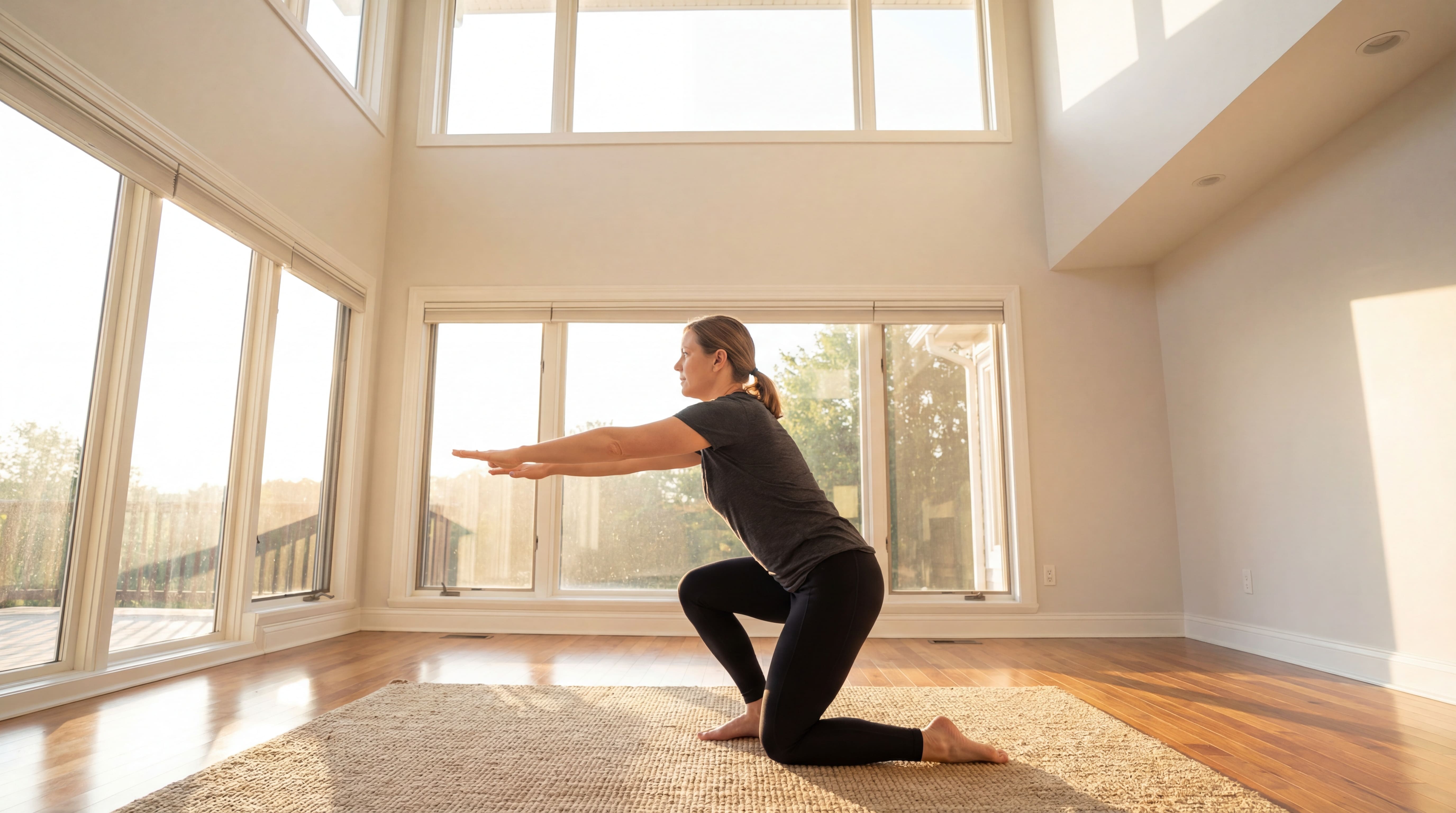
Resistance training is one of the most effective ways to preserve muscle mass while taking a GLP-1 medication, and you do not need a gym or equipment to get started (PMC). These seven exercises can be done in about 10 minutes, start gently, and build over time.
Who This Helps
This guide is for anyone on a GLP-1 medication who wants to start building a simple, at-home exercise habit to protect their muscles. It is especially helpful if you are new to exercise, coming back from a break, or looking for something you can do on days you have low energy. If you are still figuring out the basics of GLP-1 treatment, our GLP-1 basics guide covers what to know before your first prescription.
Why GLP-1 Medications Make It Harder to Keep Muscle
When you lose weight on a GLP-1 medication, not all of that weight comes from fat. Research shows that about 25% to 40% of the weight people lose on GLP-1 medications comes from lean body mass, which includes muscle (PMC). In the STEP-1 trial for Wegovy (semaglutide), lean mass dropped by about 9.7% while fat mass dropped by about 19.3% (Diabetes, Obesity and Metabolism). In the SURMOUNT-1 trial for Mounjaro (tirzepatide), about 25% of total weight lost was lean mass (American Diabetes Association).
This happens for a few reasons. GLP-1 medications reduce your appetite, which means you eat less. When your body is in a calorie deficit, it does not just burn stored fat. It also breaks down muscle for energy, especially if you are not doing anything to signal your body to keep that muscle (PMC). Older adults and women may be at higher risk for losing muscle on these medications (Endocrine Society).
The good news is that exercise, specifically resistance training, sends a strong signal to your body to hold on to muscle even while you are losing weight (Frontiers in Clinical Diabetes and Healthcare). One case series found that patients who combined resistance training 3 to 5 days per week with adequate protein lost over 91% of their weight from fat and less than 9% from muscle (PMC). That is a dramatic difference.
Why Muscle Matters More Than You Might Think
Muscle is not just about how you look. It is your body's engine for metabolism, balance, bone health, and daily function. Here is why protecting it matters:
- Muscle burns more calories at rest than fat does. Losing muscle slows your metabolism, which can make it easier to regain weight after you stop or reduce your medication. Our article on what happens when you stop taking a GLP-1 explains why this matters.
- Muscle protects your joints and bones. Reduced muscle mass is linked to higher risk of falls, fractures, and joint pain, especially as you age (PMC).
- Muscle helps regulate blood sugar. Even independent of GLP-1 medication, muscle tissue is one of the main places your body stores and uses glucose (Diabetes Care).
- Muscle supports your energy and mood. Many people on GLP-1 medications report fatigue, especially early on. Maintaining muscle can help with that. Our guide on supplements that may support your GLP-1 covers nutritional support for energy.
What this means for you: The weight you lose matters less than what kind of weight you lose. Keeping your muscle while losing fat is one of the most important things you can do for long-term health on a GLP-1.
Find a provider in your state
Answer a few questions and see live pricing from the providers that ship where you live.
A Quick Note on Protein
Exercise alone is not enough. You also need to eat enough protein to give your muscles the building blocks they need to recover. Research suggests aiming for 1.2 to 1.6 grams of protein per kilogram of body weight per day while on a GLP-1 medication (PMC). That can be tough when your appetite is low, so planning meals around protein-rich foods early in the day can help. Our meal planning guide for GLP-1 users has practical tips for this.
The Exercises
Each exercise below starts at a beginner-friendly level. Do what you can. If you can only do a few reps, that counts. Consistency matters more than intensity when you are starting out.
Suggested routine: Go through all seven exercises in order. Start with one set each. Rest 30 to 60 seconds between exercises. As you get stronger, add a second set, then a third. The whole routine should take about 10 minutes at first and closer to 15 as you build up.
1. Wall Push-Ups
Muscles worked: Chest, shoulders, triceps, core
Why it helps: This is the most accessible version of a push-up. It builds upper body strength without putting pressure on your wrists or shoulders. As you get stronger, you can move to a countertop, then a knee push-up, then a full push-up on the floor.
How to do it:
- Stand about an arm's length from a sturdy wall. Place your palms flat on the wall at shoulder height and shoulder width apart. Your fingers should point toward the ceiling.
- Keep your body in a straight line from your head to your heels. Tuck your hips slightly so your lower back does not arch.
- Slowly bend your elbows and lower your chest toward the wall. Keep your elbows at about a 45-degree angle from your body, not flared straight out to the sides.
- When your chest is a few inches from the wall, push back to the starting position by straightening your arms.
- Breathe in as you lower toward the wall. Breathe out as you push away.
Start with: 8 to 10 reps. Work up to 15, then progress to countertop push-ups.
See it done: Mayo Clinic: Modified Push-Up (Video) | Healthline: Wall Push-Up Guide
2. Bodyweight Squats
Muscles worked: Quadriceps, glutes, hamstrings, core
Why it helps: Your quads and glutes are the two biggest muscle groups in your body. Training them gives you the most return for your effort. Squats also help with balance, everyday mobility like getting up from a chair, and bone density.
How to do it:
- Stand with your feet about hip-width apart. Point your toes slightly outward, about 15 to 30 degrees.
- Clasp your hands in front of your chest or hold your arms straight out in front of you for balance.
- Push your hips back and bend your knees as if you are sitting down into a low chair. Keep your chest up and your weight in your heels.
- Lower until your thighs are roughly parallel to the floor, or as low as feels comfortable. Your knees should track over your second and third toes and should not cave inward.
- Push through your heels to stand back up. Squeeze your glutes at the top.
- Breathe in on the way down. Breathe out as you stand up.
Start with: 8 to 10 reps. Work up to 15. To make it easier, squat to a chair and lightly touch the seat before standing back up.
See it done: Mayo Clinic: Squat Exercise (Video) | ACE Fitness: Bodyweight Squat
3. Glute Bridges
Muscles worked: Glutes, hamstrings, lower back, core
Why it helps: Glute bridges strengthen the muscles on the back of your body that support your spine, hips, and knees. They are especially good if you sit for long periods during the day.
How to do it:
- Lie on your back on a mat or carpet with your knees bent and your feet flat on the floor about hip-width apart. Your heels should be about 12 to 16 inches from your glutes.
- Rest your arms flat at your sides with your palms facing down.
- Press through your heels and squeeze your glutes to lift your hips off the floor. Raise your hips until your body forms a straight line from your shoulders through your hips to your knees. Do not arch your lower back past this point.
- Hold the top position for 2 to 3 seconds. Squeeze your glutes hard at the top.
- Lower your hips back to the floor slowly and with control.
- Breathe out as you lift. Breathe in as you lower.
Start with: 10 reps with a 2-second hold at the top. Work up to 15 reps with a 3-second hold.
See it done: Mayo Clinic: Bridge Exercise (Illustrated) | Cleveland Clinic: Glute Exercises Including Bridges
4. Standing Calf Raises
Muscles worked: Calves (gastrocnemius and soleus)
Why it helps: Your calves support your ankles, help with balance, and are essential for walking, climbing stairs, and standing. They are often overlooked but matter for everyday stability, especially as you lose weight and your body adjusts.
How to do it:
- Stand with your feet about hip-width apart near a wall or counter you can lightly touch for balance.
- Keep your body straight and your core engaged. Do not lean forward.
- Slowly rise up onto the balls of your feet as high as you can. You should feel a strong squeeze in both calves at the top.
- Hold the top position for 1 to 2 seconds.
- Slowly lower your heels back to the floor with control. Do not drop down quickly.
- Breathe out as you rise. Breathe in as you lower.
Start with: 12 to 15 reps. Work up to 20. To increase difficulty, try single-leg calf raises while holding a wall for balance.
See it done: ACE Fitness: Standing Calf Raises — Wall
5. Bird Dogs
Muscles worked: Lower back, glutes, core, shoulders
Why it helps: Bird dogs train the stabilizer muscles along your spine and core. These muscles protect your back during everyday movements. This exercise also challenges your balance, which is important during weight loss.
How to do it:
- Start on all fours on a mat. Your hands should be directly under your shoulders and your knees directly under your hips. Keep your back flat like a tabletop.
- Brace your core by tightening your stomach muscles as if someone were about to poke your belly.
- Slowly extend your right arm straight forward and your left leg straight back at the same time. Reach forward with your fingers and backward with your toes. Your arm, back, and leg should form one straight line.
- Hold for 3 to 5 seconds. Focus on keeping your hips level and not letting them rotate or tilt to one side.
- Slowly return your hand and knee to the floor.
- Repeat on the other side: left arm forward, right leg back.
Start with: 5 reps per side with a 3-second hold. Work up to 8 reps per side with a 5-second hold.
See it done: ACE Fitness: Bird Dog | Healthline: Bird Dog Exercise Guide
6. Modified Plank (Knee Plank)
Muscles worked: Core (deep abdominals, obliques), shoulders, chest, lower back
Why it helps: The plank builds core stability, which supports your spine during every other exercise and every movement in daily life. Starting on your knees makes it accessible even if a full plank feels too hard right now.
How to do it:
- Start by kneeling on a mat. Place your forearms on the floor with your elbows directly under your shoulders. Your forearms should be parallel to each other, palms flat or lightly clasped.
- Walk your knees back slightly so your body forms a straight line from your head through your hips to your knees. Do not let your hips sag toward the floor or pike up toward the ceiling.
- Tuck your hips slightly to engage your lower abs. Squeeze your glutes gently.
- Hold the position. Keep breathing steadily. Do not hold your breath.
- Focus on keeping your body rigid like a plank of wood.
Start with: Hold for 15 to 20 seconds. Rest and repeat twice. Work up to 30-second holds, then progress to a full plank on your toes.
See it done: Harvard Health: Move of the Month — Modified Front Plank
7. Step-Ups (Using a Stair or Low Step)
Muscles worked: Quadriceps, glutes, hamstrings, calves, core
Why it helps: Step-ups mimic a movement you do every day, climbing stairs, but turn it into a muscle-building exercise. They build single-leg strength and balance, which are especially important as your body composition changes.
How to do it:
- Stand in front of a bottom stair step or a sturdy low platform (6 to 8 inches high to start).
- Place your entire right foot flat on the step. Make sure your whole foot is on the surface, not just the ball of your foot.
- Press through your right heel and step up until your right leg is straight. Bring your left foot up to meet your right foot on the step.
- Step back down with your left foot first, then your right foot. That is one rep.
- Complete all reps on one side, then switch to leading with your left foot.
- Keep your chest up, core engaged, and avoid leaning forward or pushing off your back foot. The front leg should do the work.
- Breathe out as you step up. Breathe in as you step down.
Start with: 6 to 8 reps per leg. Work up to 12 per leg. To increase difficulty, use a higher step or hold water bottles for added weight.
See it done: Mayo Clinic: Step-Up Exercise (Video)
How to Build This Into a Routine
Start with one set of each exercise, going through the list from top to bottom. Rest 30 to 60 seconds between exercises. The first week, focus on learning the movements. Do not worry about how many reps you can do.
After the first week or two, try adding a second set of each exercise. After a month, aim for three sets. You can also start progressing to harder versions: countertop push-ups instead of wall push-ups, deeper squats, single-leg calf raises, and full planks.
Try to do this routine at least two to three times per week. Research shows that even two sessions of resistance training per week is enough to see meaningful improvements in strength and muscle preservation (Frontiers in Clinical Diabetes and Healthcare).
If you want more guidance on building habits while on a GLP-1, our article on top mistakes people make on GLP-1 therapy covers common pitfalls including skipping exercise.
Final Takeaway
Losing weight on a GLP-1 medication is only part of the picture. What kind of weight you lose matters just as much. Muscle protects your metabolism, your bones, your balance, and your ability to stay active long-term. You do not need a gym membership or fancy equipment. You need consistency, a few basic movements, and enough protein to support the work. Ten minutes a few times a week is enough to start making a real difference. Start where you are. Build from there.
If you enjoy posts like these, you can subscribe to receive newsletter updates.
Find a provider in your state
Answer a few questions and see live pricing from the providers that ship where you live.
Keep Reading
Learn what to expect before starting a GLP-1 — supplies, mindset, telehealth basics, safety tips, and how to prepare for your first dose.
Research shows weight regain after stopping Ozempic or Wegovy. See how fast it happens, what else reverses, and what you can do now to keep results.
%2520(1).jpg&w=3840&q=100)
Not hungry on GLP-1s? Keep it simple: quick proteins, fiber, hydration tips, and a flavorful 20-min recipe anyone will love.
Learn how to preserve and build muscle while losing weight on GLP-1s, including strength training, protein intake, and realistic expectations.
Written by
 Lauren Pescarus
Lauren Pescarus is a team member with GLP Winner where she works on marketing, content creation, and operations. She has over 10 years experience in the content creation space, including in the GLP-1 space where she works to stay on top of access news, research updates, and lifestyle tips guided by science.